
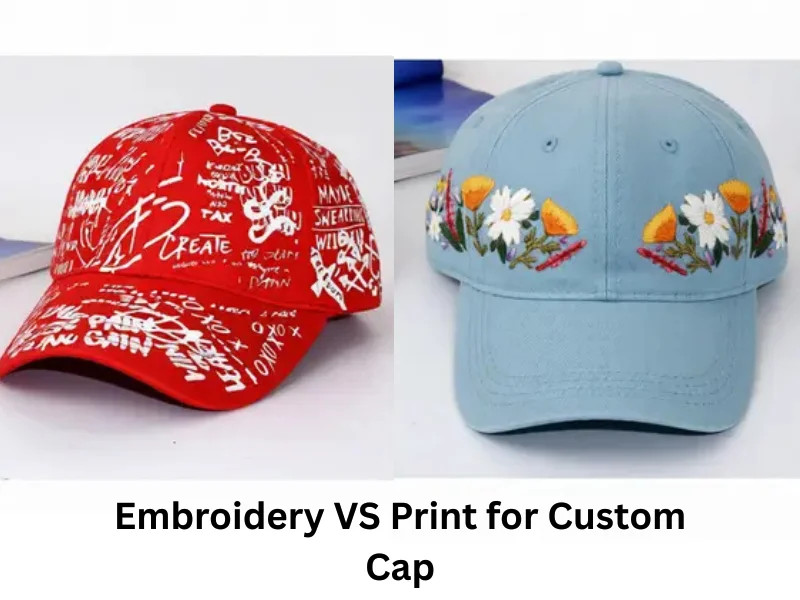
How to Choose Between Embroidery and Print for Custom Caps
Most people decide between embroidery and print the same way they decide most things they don’t fully understand: by guessing which one looks more expensive, or just going with whatever the print shop pushes first. Neither tells you anything useful. The real question is what your cap has to survive. A cap that gets washed every week and sits in the sun all summer needs something different from one that gets worn once at an event and never touched again. That’s where the real gap between the two shows up, not in how sharp the logo looks on day one, but in what’s left of it three months later. Once you know what it’s up against, the rest is simple.
What Embroidery Actually Does to a Cap
Embroidery works by stitching your design directly into the fabric with thread, not laying it on top. That’s the part most people miss, and it’s also why it holds up so differently over time. Wash it, leave it in the sun for a season, and the stitching barely notices. Most custom embroidered caps still look sharp years after the cap itself has started fading or losing shape. That’s also why embroidery reads as premium rather than promotional. It has weight to it, the kind of finish you’d expect on a uniform or a brand someone actually invested in, not something handed out at a booth. The trade-off shows up in detail. A thread can hold a clean logo or bold text, but it can’t handle gradients, shading, or anything close to a photo. Ask for too much detail, and the design just turns into a blurry mess of stitches.
What You Get With Print
How it’s applied
Print sits on top of the fabric instead of being woven into it. Ink, vinyl, or a heat transfer film gets pressed onto the surface rather than stitched through it.
Where it wins
This is exactly why print can do things embroidery can’t. Full colour, gradients, fine detail, even something close to a photograph, all things thread simply can’t reproduce.
Where it falls short
Anything sitting on the surface is more exposed to wear. Cheaper vinyl or transfer film can start cracking or peeling after a few dozen washes, which is the most common complaint with bargain printed caps.
Why DTF changed things
Print on caps isn’t what it used to be. DTF transfers flex with the fabric and hold colour far better than old-school screen printing did. It’s still not as tough as embroidery, but it’s no longer the flimsy option it once was.
Embroidery vs Print
| Embroidery | ||
| Durability | Holds up for years without fading | Can crack or peel over time, especially cheap vinyl |
| Detail level | Best for simple logos and text | Best for gradients, full colour, photo-style designs |
| Small orders | Usually cheaper | Setup costs make it pricier |
| Bulk orders | The setup cost adds up per unit | Usually cheaper per cap |
| Weather | Resists sun, rain, and washing well | Fades or lifts faster outdoors |
| Best for | Uniforms, team caps, brand gear | One-off events, giveaways, and detailed art |
What the Weather Does to Your Cap
This is where the two methods stop being equal. Weather treats them very differently, and it shows up faster than most people expect:
- Direct sun: UV exposure fades printed ink over time. Embroidered thread barely shifts colour, even after seasons outdoors.
- Sweat and rain: Moisture works against a printed surface faster than people think. Stitched thread doesn’t react the same way at all.
- Off-season storage: Caps crushed or folded away for winter can crack a printed design right at the fold. Embroidery has no surface layer to crack in the first place.
So if you’re trying to choose the right hat for any season, not just one that looks sharp for a month of photos, embroidery is generally the one that holds up outdoors. Print isn’t a bad option, it just wears down faster the more actual weather it goes through.
Where the Cost Actually Comes From
Embroidery pricing comes down to two things: stitch count and a one-time digitising fee, usually somewhere around £15 to £30, that turns your logo into a file the machine can sew. After that, you’re paying per stitch, not per colour. A simple three-colour logo costs the same to embroider as one with ten.
Print works differently. Cost depends on the size of the design and, with screen printing, how many colours it has, since each colour needs its own screen. More colours mean more setup and more cost.
This is why “embroidery is always pricier” isn’t actually true. On a small order of a dozen caps, the embroidery setup fee gets spread thin, and the per-piece cost stays reasonable. On a bulk order of a few hundred, the print’s setup costs spread out instead, and it usually ends up cheaper per cap.
Most people overpay for personalised caps for one simple reason: they pick a finish before checking what it costs to produce at their actual order size. Three things move the price more than anything else:
- Simplify the design: Every extra colour or fine detail adds setup time and cost, on both embroidery and print.
- Order at the right volume: Most suppliers have price breaks at certain quantities. Going from 40 to 50 caps sometimes drops your per-unit cost more than switching methods would.
- Match the method to your order size: Small batch, embroidery. Bulk batch, print.
If you’re after the cheapest personalised caps in UK without the finish looking cheap, work through it in this order: design first, quantity second, method last.
Why the Cap Material Decides for You
Sometimes the choice isn’t really about preference. The fabric decides for you before you’ve even opened the price list.
Mesh caps are an open weave built to let air through, and that openness gives embroidery nothing stable to anchor into. The stitching ends up loose, lifted, or fraying within weeks, which makes print the only realistic option there.
Beanies and other knit caps run into the opposite problem. The fabric stretches, and a surface print cracks or peels almost immediately on something that flexes that much. Embroidery’s stitches bond into the knit fibres instead, so the design moves with the fabric rather than fighting it.
Structured caps with a stiff front panel are a rare middle ground. Cotton and twill both hold up fine with either method, which is really why most of the “which one’s better” debate only applies to this one style of cap.
When the Cap Is About the Brand, Not Just You
Why is it not the same decision anymore
The moment a cap represents a business rather than just yourself, the durability question becomes much more serious. A team cap, a corporate gift, or a uniform isn’t replaced after one wear. It’s expected to survive an entire season of events without looking tired by month three.
What people actually notice
This is where the perception gap shows up. A printed cap, even a sharp one, still reads as merch. Embroidery reads differently, carrying the texture and weight people associate with a brand that invested in how it shows up.
Why most businesses still pick embroidery
That difference is exactly why most businesses choose to promote their brand with custom embroidered hats instead of printed ones for anything long-term, from staff caps to client gifts. It’s the option that still looks intentional a year in, not just on day one.
When print still makes sense
None of these excludes or discards print entirely. For a one-off campaign or a conference giveaway, something realistically worn once and forgotten, print still gets the job done without embroidery’s extra setup cost.
FAQs
Does embroidery last longer than print on caps?
Yes, in most cases. The thread is stitched into the fabric instead of sitting on top, so it holds up against washing, sun, and daily wear far better than ink or vinyl.
Is embroidery always more expensive than print?
Not for every order. Small batches are often cheaper to embroider, while print tends to come out ahead once you’re ordering in bulk and the per-unit cost drops.
Can you combine embroidery and print on the same cap?
A lot of caps use embroidery for the main logo and print for smaller details, giving you durability where it counts and flexibility everywhere else.
Final Thought
At this point, you don’t need another comparison chart. You need to ask yourself three quick questions: how many caps you need, what they’ll go through, and who’s wearing them once they’re out the door. The answer to those three questions tells you more than any spec sheet on embroidery or print ever will. If you’re ordering a handful for a one-off event, print probably gets the job done. If it’s a brand cap, a uniform piece, or something meant to last past one season, embroidery is worth the extra setup cost. Stop comparing methods and start with your actual order. The right choice usually picks itself once you do.
I am the lead content creator of the CapsCompany.co.uk blog, which provides valuable insights into the craftsmanship and behind-the-scenes processes of custom headwear.My posts go deep into covering the quality of the embroidery, the cap, the branding, and the promotional merchandise. I would like to demonstrate to companies the power of custom cap design in enhancing brand awareness and establishing relationships with customers.